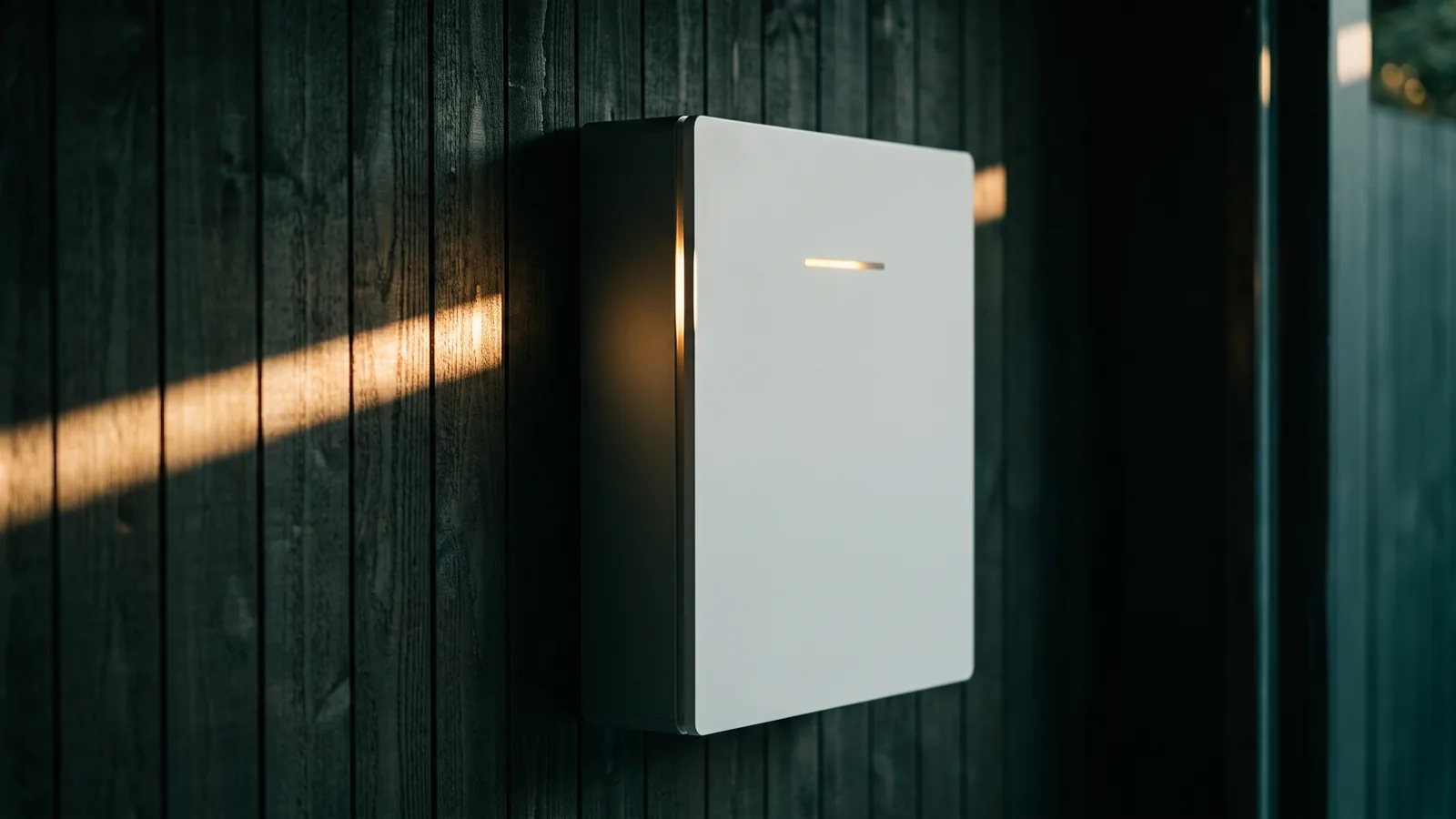
How a battery pairs with solar panels
Panels and a battery do two different jobs. The panels make power while the sun is up. The battery moves some of that power to when you actually want it, which for most households is between 4pm and 10pm. That is the whole proposition, and it only pays when the gap between what your retailer pays for an exported kWh and what it charges you to buy one back in the evening is wide enough. In 2026 it usually is: typical feed-in rates run 1–9.33 c/kWh across the states, and NSW, VIC, SA and ACT have no regulated minimum at all, while the evening rate you are billed at is several times that wherever you live. The rate in your state is on feed-in tariffs by state.
What a home battery does:
- Stores surplus daytime solar, typically 10–13.5 kWh of it, and discharges it through the evening peak instead of you buying that power back from the grid.
- Keeps part or all of the house running in a blackout, but only if it is specified that way. 3 of the 9 batteries we list do whole-home backup; the rest need an essential-circuits sub-board, and some need a separate gateway.
- Earns money in a Virtual Power Plant, where a retailer pays you to discharge into the grid on the handful of evenings a year the market is short.
- Attracts the federal Cheaper Home Batteries rebate, currently 6.8 certificates per usable kWh, or about $271 per kWh on the first 14 kWh before installer admin fees, and typically $244–$252 per kWh after them.
What a home battery does not do:
- Make more power. A battery adds no generation at all. If your panels do not already produce a daily surplus, the battery will sit part-empty and the payback maths falls apart.
- Take you off the grid. A grid-connected battery is sized for one evening, not for a week of rain, and going off-grid is a different and far more expensive build.
- Keep working through a blackout by default. Without backup hardware a battery shuts down with the grid for anti-islanding safety, the same as your inverter.
- Pay for itself on exports alone. The saving comes from the power you stop buying, not the power you sell.
If you do not have panels yet, price the two halves together rather than separately: see solar panels in Australia for the panel side, and the package table further down for what the pair costs after rebates in your state.
Solar battery sizes and prices, 5 to 20 kWh
Battery cost scales with usable capacity, but not in a straight line. The install labour, switchboard work and network paperwork are much the same whatever the size, so the price per usable kWh generally falls as capacity rises. The break in that pattern is at 14 kWh: above it, the federal rebate pays on only 60% of each extra kWh, so capacity past the fourteenth costs more out of pocket than any of the capacity below it.
| Usable capacity | Installed, before rebate | Federal rebate | After rebate | Suits |
|---|---|---|---|---|
| 5 kWh | $2,500–$3,200 | −$1,357 | ~$1,493 | The smallest capacity the federal rebate accepts, and the smallest any listed model can be configured at. One modular system reaches it, so treat the band as indicative. |
| 10 kWh | $7,000–$13,500 | −$2,713 | ~$7,537 | The most-quoted size in Australia. Modular stacks sit near the bottom of the range, premium all-in-one units near the top. |
| 13.5 kWh | $7,800–$14,500 | −$3,631 | ~$7,519 | Powerwall 3 class, and the last capacity the federal rebate pays on in full. One box with an integrated inverter and whole-home backup is what the top of the range buys. |
| 15 kWh | $7,500–$12,500 | −$3,950 | ~$6,050 | Reached by stacking modules rather than by one unit, which is why it can undercut a 13.5 kWh all-in-one outright. Almost all of the capacity still sits inside the 14 kWh the rebate pays on in full. |
| 20 kWh | $10,000–$20,600 | −$4,748 | ~$10,552 | Above 14 kWh the federal rebate only pays on 60% of each extra kWh, so every kWh past the fourteenth costs noticeably more to add than the ones before it. |
Bands are our own arithmetic on the battery models we list, verified 13 July 2026; the rebate column is computed from the current federal factor of 6.8 certificates per usable kWh, verified 13 July 2026, and "after rebate" applies it to the midpoint of the band. State incentives come off after that. Planning estimates, not quotes. The 30 kWh row, the per-kWh column and the model-by-model workings are on solar battery prices.
One result is worth reading twice. Because the rebate keeps scaling with capacity while the hardware price per kWh keeps falling, a 13.5 kWh battery lands at roughly the same out-of-pocket as a 10 kWh one ($7,519 against $7,537) for 35% more storage. If you are choosing between the two on price alone, the bigger one is usually the better buy.
Solar and battery package price by state
The package most Australian households actually buy is a 6.6 kW system, 15 panels on a 5 kW inverter, with a 13.5 kWh battery. That costs $14,100–$23,100 fully installed before rebates. What changes by state is the stack that comes off it: the federal STC rebate on the panels varies with your solar zone, the federal battery rebate is the same everywhere, and only a couple of states add anything of their own.
| State | Federal STCs (panels) | Federal battery rebate | State incentives (max) | Package at the maximum |
|---|---|---|---|---|
| NSW | −$1,796 | −$3,631 | −Up to $1,500 | ~$11,673 |
| WA | −$1,796 | −$3,631 | −$1,300 | ~$11,873 |
| VIC | −$1,556 | −$3,631 | −Up to $1,400 | ~$12,013 |
| NT | −$1,995 | −$3,631 | None active | ~$12,974 |
| QLD | −$1,796 | −$3,631 | None active | ~$13,173 |
| SA | −$1,796 | −$3,631 | None active | ~$13,173 |
| ACT | −$1,796 | −$3,631 | None active | ~$13,173 |
| TAS | −$1,556 | −$3,631 | None active | ~$13,413 |
Package price is the midpoint of the combined band ($18,600) less the stack. Federal STCs are computed for each state's own solar zone rating at the current certificate price; the battery rebate is computed at 6.8 certificates per usable kWh. Both verified 13 July 2026. Only NSW (PDRS Virtual Power Plant connection incentive) and WA (WA Residential Battery Scheme, Synergy customers) currently add a battery incentive a general household can claim, and only VIC adds a point-of-sale rebate on the panels, which is income-tested. Victoria's battery loan and Queensland's Battery Booster have both closed. Follow your state's link for the eligibility rules and the source.
The two federal rebates are formulas: they pay what the table says. The state incentives marked "up to" are not. NSW's PDRS Virtual Power Plant connection incentive is capped at $1,500 but the program's own published typical payout is $550–$1,100, which puts the same package nearer $12,073–$12,623 . Victoria's panel rebate is income-tested. So the last column is a best case across the country of about $11,673 to $13,413, and which state actually comes out cheapest depends on what each household is assessed as eligible for, not on the ranking above. Check your own figure before you count on it.
Every state's own page sets out what it pays and who qualifies; the federal Cheaper Home Batteries rebate explains the part that is identical everywhere, and the calculator applies your postcode's actual stack.
The federal rebate drops on 1 January 2027
The Cheaper Home Batteries Program pays 6.8 certificates per usable kWh today. On 1 January 2027 that falls to 5.7. The same 13.5 kWh battery goes from $3,631 of federal support to $3,032, so $599 less off an otherwise identical install. Certificates are earned on the date the install is certified, not the date you sign the contract, so a job booked close to the deadline can miss it. The schedule then steps down every 1 January and 1 July until 2030.
The battery rebate falls every six months. On a schedule.
This is not marketing pressure, it is legislation. The federal factor is 6.8 STCs per usable kWh until 31 December 2026, drops to 5.7 on 1 January 2027, and keeps stepping down until the program ends in 2030. On a 13.5 kWh battery, that first step alone is worth about $599.
Source: DCCEEW, Cheaper Home Batteries Program. Schedule verified 13 July 2026, reviewed at least annually by the regulator.
That is honest urgency, not a sales deadline: the dates are legislated and published by the Clean Energy Regulator, and nothing about waiting changes the hardware. The full schedule in dollars is on the battery rebate page, and the rebate calculator gives the figure for your own postcode and battery size.
Which battery, and which brand
Once capacity is settled, three things separate the models and nothing else much does. Whether the battery brings its own inverter, which decides if you need a hybrid inverter added. What happens in a blackout, which decides whether you need a changeover gateway or an essential-circuits sub-board. And warranty length, which is where most of the price spread between tiers actually goes. Every battery we list uses LFP chemistry, so cell quality is not the differentiator it was five years ago.
| Battery | Usable kWh | Inverter included | Backup | Warranty |
|---|---|---|---|---|
| Tesla Powerwall 3 | 13.5 | Yes | Whole-home | 10 years |
| Sungrow SBR HV | 12.8 (9.6–25.6 kWh) | No | Add-on | 10 years |
| BYD Battery-Box Premium HVS | 10.2 (5.1–22.1 kWh) | No | Add-on | 10 years |
| GoodWe Lynx Home F | 10.6 (5.4–16.4 kWh) | No | Add-on | 10 years |
| Sigenergy SigenStor | 16 (8–48 kWh) | Yes | Whole-home | 10 years (15 with VPP) |
| sonnenBatterie Evo | 10 | No | Add-on | 10 years / 10,000 cycles |
| Growatt APX | 15 (5–30 kWh) | No | Add-on | 10 years |
| Fox ESS EQ4800 (~10 kWh) | 10 | No | Add-on | 10 years / 70% capacity retention |
| Alpha ESS SMILE5 | 13.3 | Yes | Whole-home | 10 years / 70% capacity retention |
Specifications as published by each manufacturer, checked 13 July 2026. Price per model, before and after the rebate, is on solar battery prices.
The side-by-side, with what each one is actually good at, is in best home batteries 2026. For the panel, inverter and battery manufacturers themselves, including warranty terms and Australian support, see our brand pages.
Should the battery join a VPP?
A Virtual Power Plant pays you to let a retailer discharge your battery into the grid when wholesale prices spike. In NSW it is also the mechanism behind the state's battery incentive: up to $1,500 of the NSW stack above is paid for connecting to an approved VPP, not for buying the battery. That is worth knowing before you sign, because a VPP trades a share of your stored power, and therefore some of your own evening saving, for a payment or a bill credit.
Whether that trade is worth it depends on the program's discharge limits, the guaranteed floor and how much of the battery you want reserved for blackout backup. The programs, the payment models and what each one asks of you are set out on Virtual Power Plants.
Battery prices in the capital cities
Battery hardware costs the same in every capital. What differs is the rebate stack, the feed-in tariff your exports earn and the network you have to get approval from, which together move both the price and the payback. Each city page carries the local numbers:
- Solar and batteries in Sydney (NSW) — zone 3, $1,796 in STCs on a 6.6 kW system
- Solar and batteries in Melbourne (VIC) — zone 4, $1,556 in STCs on a 6.6 kW system
- Solar and batteries in Brisbane (QLD) — zone 3, $1,796 in STCs on a 6.6 kW system
- Solar and batteries in Adelaide (SA) — zone 3, $1,796 in STCs on a 6.6 kW system
- Solar and batteries in Perth (WA) — zone 3, $1,796 in STCs on a 6.6 kW system
- Solar and batteries in Hobart (TAS) — zone 4, $1,556 in STCs on a 6.6 kW system
- Solar and batteries in Canberra (ACT) — zone 3, $1,796 in STCs on a 6.6 kW system
- Solar and batteries in Darwin (NT) — zone 2, $1,995 in STCs on a 6.6 kW system
For the companies themselves, our installer directory lists public Australian Business Register records: legal entity, ABN and trading names. No ratings, no reviews, just the register.
Common questions about solar batteries
How long will a 10 kWh battery last?
Two different questions, and people usually want both. Through one evening, it depends entirely on what is switched on: a house idling overnight draws a fraction of what the same house draws with ducted air-conditioning or an electric oven running, which is why a battery's power rating in kW decides as much as its capacity in kWh. Put your own bill through the calculator rather than trusting a headline number. Over its life, the LFP batteries we list at this capacity are warranted for 10 years. That warranty, rather than any headline lifespan, is the number to plan on: it is the manufacturer stating what share of the original usable capacity the battery is guaranteed to still hold when the term ends.
Is it worth getting a battery for solar panels?
It turns on two things: what your retailer pays for an exported kWh, and how much of your power you use after dark. Typical feed-in rates now run 1–9.33 c/kWh depending on the state, and NSW, VIC, SA and ACT have no regulated floor at all, so exporting is worth much less than it was. The federal rebate takes $3,631 off a 13.5 kWh battery at the point of sale, and a state incentive stacks on that in NSW and WA. If the house is busy between 4pm and 10pm the case is strong; if it is empty then, panels alone are the better buy. Payback depends on your own bill and tariff, so run it through our calculator rather than taking an average. Figures verified 13 July 2026.
Which 10 kW solar battery is the best in Australia?
First, the units: batteries are sold in kWh (how much they store), not kW (how fast they deliver it), so a "10 kW battery" almost always means 10 kWh. At that capacity we list BYD Battery-Box Premium HVS, GoodWe Lynx Home F, sonnenBatterie Evo, Fox ESS EQ4800 (~10 kWh). There is no single best one, because they are not the same product: the cheapest per usable kWh is the GoodWe Lynx Home F at about $755 per kWh, while the dearer units in that band buy longer cycle warranties or an integrated inverter. Only 3 of the 9 batteries we list offer whole-home blackout backup, and that is usually the feature worth paying for. The full comparison is on our best home batteries page.
How many solar panels do I need to charge a 10 kWh battery?
About 6 panels, on top of whatever the house uses during the day. At 440 W each that is roughly 2.64 kW of array, which produces around 10 kWh on an average Australian day. In practice installers size the array for daytime household load first and the battery second, which is why a 10 kWh battery is normally quoted next to a 6.6 kW system of 15 panels rather than 2.64 kW of panels on their own.
What is the best solar and battery package for NSW?
For most Sydney and regional NSW homes it is a 6.6 kW system of 15 panels with a 13.5 kWh battery. That package costs $14,100–$23,100 installed before rebates, and NSW stacks three things against it: $1,796 in federal STCs on the panels, $3,631 from the federal Cheaper Home Batteries Program, and up to $1,500 from the PDRS Virtual Power Plant connection incentive. The two federal amounts are formulas and pay what they say; the NSW incentive is a ceiling, with a published typical payout of $550–$1,100. That puts the package at about $11,673 out of pocket at best, and nearer $12,073–$12,623 on the typical payout. Rebate figures verified 13 July 2026; the NSW battery rebate page has the eligibility rules.
Get the battery price for your address
Every figure above is a national planning range. Your number depends on the switchboard, the roof, which network you are on and whether your existing inverter is battery-ready. Tell us the address and the bill, and we match you with one installer we have checked against the ABN record. One installer, one quote, no call-centre bidding.